
I've noticed over the last few days a huge (for me, anyway) spike in blog traffic, so I'd like to say to those of you finding my blog thanks the Blogger navigation bar, welcome. And now to the promised cool links:
Do you like Space Ghost Coast to Coast? Here are a couple of "lost" episodes I wrote and produced for GameTap.com.
Do you like Tomb Raider? In 2007, I produced a ten episode animated web-series featuring versions of Lara Croft by some of the most talented people in comics, including Jim Lee, Gail Simone, Warren Ellis, Cully Hamner, Christos Gage, and Brian Pulido, featuring the voice of Minnie Driver as Lara Croft. You can check out select episodes here. (And more on YouTube, I'm sure!)
Are you a fan of classic console gaming? Perhaps a big Dave Foley fan? Then you certainly will want to check out the 6-episode Re\Visioned: Activision, a series of animated shorts based on the classic Activision 2600 games Pitfall, Cosmic Ark, Pressure Cooker, Kaboom, Freeway, and H.E.R.O. There's some pretty funny stuff there.
Thanks for stopping by,
EB
Showing posts with label comics. Show all posts
Showing posts with label comics. Show all posts
Wednesday, February 3, 2010

Tuesday, February 2, 2010

Monday, February 1, 2010
Work in Progress
I've been scripting my graphic novel, The Package, and I thought it might be interesting to provide a look at my comic book writing process, which I suspect is a little more circuitous than the process of a more seasoned comics writer.
Generally, no matter what it is I'm writing, I start with extensive notes in a notebook or on a legal pad. Every project, though, takes a life of its own, and when I was outlining this one, it went almost directly into the computer. But when I started scripting, back to the legal pad I went:

The big difference between scripting for animation and for comic books is that in comics, you're not just describing action, but instead a specific moment of action, because that's what you get in a single panel. I use the legal pad to rough out my dialogue, and to start thinking about what moments I want to see in each panel. It's also at this stage that I start thinkng about how those panels might flow, and how many I might want to use per page. However, since I'm not an artist, this is the part I find most difficult. So I've come up with a solution...
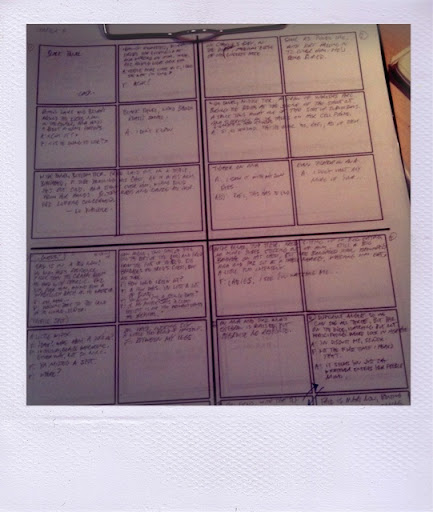
...a thumbnail sheet. I've decided for this story to plan out each page on a six-panel, three-tiered page. For the most part, I feel like I can get across everything I want to get across in six panels or less per page. I also think this keeps me from crowding the page with too much action or dialogue, and gives the artist for this project, Alexis Ziritt, enough room to work. You'll notice, though, that I'm not actually drawing crude stick-figures on the thumbnail pages - instead, I'm filling in each panel with description and dialogue, which gets revised from the legal pad stage as I go. This is the only way I've figured out (so far) how to make sure that I've got the pacing of the story and its moments to my liking. (I also think this is where my process gets a little unusual, but I could be wrong about that.) Once I'm done scribbling words in those little panels, I move on to the actual scripting:

Dialogue gets a final tweaking here, as do panel descriptions and pacing. But so far, not too much. Even though I'm typing the script for the first time, it's really almost a third draft. Works for me.
-EB
- Posted using BlogPress from my iPhone
Generally, no matter what it is I'm writing, I start with extensive notes in a notebook or on a legal pad. Every project, though, takes a life of its own, and when I was outlining this one, it went almost directly into the computer. But when I started scripting, back to the legal pad I went:
The big difference between scripting for animation and for comic books is that in comics, you're not just describing action, but instead a specific moment of action, because that's what you get in a single panel. I use the legal pad to rough out my dialogue, and to start thinking about what moments I want to see in each panel. It's also at this stage that I start thinkng about how those panels might flow, and how many I might want to use per page. However, since I'm not an artist, this is the part I find most difficult. So I've come up with a solution...
...a thumbnail sheet. I've decided for this story to plan out each page on a six-panel, three-tiered page. For the most part, I feel like I can get across everything I want to get across in six panels or less per page. I also think this keeps me from crowding the page with too much action or dialogue, and gives the artist for this project, Alexis Ziritt, enough room to work. You'll notice, though, that I'm not actually drawing crude stick-figures on the thumbnail pages - instead, I'm filling in each panel with description and dialogue, which gets revised from the legal pad stage as I go. This is the only way I've figured out (so far) how to make sure that I've got the pacing of the story and its moments to my liking. (I also think this is where my process gets a little unusual, but I could be wrong about that.) Once I'm done scribbling words in those little panels, I move on to the actual scripting:
Dialogue gets a final tweaking here, as do panel descriptions and pacing. But so far, not too much. Even though I'm typing the script for the first time, it's really almost a third draft. Works for me.
-EB
- Posted using BlogPress from my iPhone
Tuesday, January 19, 2010
The Package

A crime comic by me and illustrator Alexis Ziritt. We started this way back in the summer of 2008, but due to a variety of circumstances - including our soon to be published story Mekano Turbo, due out February 24 in Popgun Comics Vol. 4 - it's been delayed. But we're back it at it - date of publication TBD.
If you like the image above, feel free to copy it - it's wallpaper size for your desktop. Oh, yeah.
EB
Monday, November 9, 2009
Mekano Turbo in Popgun Vol. 4

Here it is, folks - the Popgun website has gone live with info and previews for Popgun Vol. 4, due out February 10, 2010 from Image Comics, and featuring an 8-page Mekano Turbo story (previewed previously right here on this very blog) illustrated by Alexis Ziritt and written by me. Clocking in at 512 pages of comics goodness, and billed as "the ultimate graphic mixtape by today's superstar creators and fresh new talent." I guess Alexis and I qualify as fresh and new, while my friend and future animated project collaborator Jeffrey Brown, who also has a story in this volume, would be a superstar. It's very cool. Pre-order one from your local comic shop, won't you?
EB
Monday, April 6, 2009
Mekano Turbo! The Package!
For your enjoyment, the first page of MEKANO TURBO:
 Created and drawn by Alexis Ziritt, written by me, headed for Popgun Vol. 4. Volume three of Popgun is out this week I believe, and sports a great cover by Tara MacPherson, who worked with me briefly at Rough Draft Studios back in the day.
And for your further enjoyment, page 1 of THE PACKAGE:
 Created and written by me, illustrated by Ziritt, headed for the web later this year.
More updates when they're available!
Thursday, April 2, 2009
Making of Re\Visioned: Activision - The Backstory
I've been promising this on Twitter for several days now, so let's get to it - a behind the scenes look at the making of each episode of Re\Visioned: Activision. But first, a little history:
 Re\Visioned was created by my former boss at GameTap, Ricardo Sanchez, who thought it would be cool create some original animation based on existing videogame IP from the GameTap library. But rather than doing a straight adaptation of these games, Rick wanted to present new takes on the games, or as he put it, "revisioned." And when he added a backslash between "re" and "visioned," a title was born.
Initially, Rick wanted to hire great animators to spearhead the project, but given the budget and time restraints, he was willing to entertain other ideas - which is when I floated the notion of hiring comic book writers and artists to handle story and art, with the idea that those things could be handed off to an animation studio for production. He liked the idea, and then we all went back to what we were doing.
A few months later, Rick struck a deal with The Hero Initiative, a non-profit comic book industry group that raises money to help industry veterans who gave years to the business, often without a safety net or retirement plan. The Hero Initiative would provide scripts and art from a mix of popular current creators and respected veterans in need of work. Included in the group were writers Mark Waid, Paul Jenkins, John Ostrander, William Messner-Loebs, the late Steve Gerber, and Hero Initiative president Jim McLauchlin; and artists Dave Simons, Armando Gil, Joe Rubenstein, Flint Henry, Bob Hall, and Claude St. Aubin. A really talented bunch.
Scripts were written, designs were drawn. And then a decision was made at GameTap to move Re\Visioned: Tomb Raider, a more high-profile, super ambitious project intended to be season two of the series to the head of the line. The Activision project was put on the back-burner, and approved scripts and designs languished for close to a year.
When we finally did get back to Re\Visioned: Activision, the bar had been raised significantly by the quality and complexity of Re\Visioned: Tomb Raider, and while we had less money to throw at Activision, my executive producer, Chris Peeler, and I knew that we needed to find a way to live up to R:TR. With that thought in mind, we went back in to the Activision materials we had commissioned, and found that while we had a good project, some of the scripts were too modest in scope. After consulting with the boss, it was agreed that we would use the materials created by the Hero Initiative as a starting point...
More tomorrow.
-EB
Friday, March 27, 2009
Comics, Big Stack Of
Went to the comic shop yesterday with some birthday cash in hand and bought a big stack, which is always fun. But before I get into what I bought, I want to relate a little story about the store itself. While I was browsing the new releases, the manager and a staffer came over with the new order book and started trying to figure out what they should be ordering, by looking at what was on the shelves and counting what was left over. The manager actually said, "I wonder how many of those we actually sold?" This store is regarded as the best in Atlanta - possibly because it's the only one I can find inside the perimeter - and the manager didn't have any idea how much they were selling, which means that they were ordering in the dark. Before yesterday, I had not noticed the absence of a POS (point of sale) system, which means they're not using the bar codes on the comics, GN's, and various merchandise they sell to track their inventory. I am not a retailer, but I'm the son of one, and, really, you don't have to be the son of a retailer to realize this is a really bad way to manage your business. Comics retailer Brian Hibbs writes extensively about the benefits and insights gained from using a POS system in his column Tilting at Windmills, so if you're at all interested in this, it's worth checking out.
Now, to the fun stuff - here's what I bought:
-EB
Now, to the fun stuff - here's what I bought:
- Captain America #48 - Ed Brubaker's run on Captain America has been outstanding, and the Butch Guice art on this arc is the best I've ever seen from him. Really great stuff. Killing off Steve Rogers and bringing back Bucky could have been hokey, but Brubaker's mastery of character has made this a compelling read every month for four years now, and that's quite an accomplishment.
- Daredevil #117 - Another great run on a book by Ed Brubaker, who for my money is one of the top three writers in comics. The Kingpin made his return last issue, and Brubaker, along with artist David Aja, showed us a side of Wilson Fisk that we've never seen. The great runs on Daredevil have always been less about the costume and more about the man inside it, and there's no character in comics with more drama in his life than Matt Murdock. Bad for him, but good reading for us, which is what it's all about.
- Black Lightning #6 - A good updating of the characters origin. I usually buy a comic for the writing, but this one was all about the art, and I don't think I've seen anything finer from Cully Hamner. (Who, in the interest of full disclosure, is a friend.)
- Fantastic Four #565 - I've really enjoyed Millar & Hitch's FF - it's no Ultimates, but it's been entertaining and typically full of big Millar ideas.
- Scalped #26 - One of the best comics currently being published, by writer Jason Aaron and artist R.M. Guera (although this issue is drawn by Davide Furno). Crime stories at their most brutal. I wrote about Scalped extensively here.
- Ex Machina Special #4 - Lost writer/producer Brian K. Vaughn's political fable set in New York, following the exploits of its mayor, the world's first and only superhero.
- Potter's Field: Stone Cold - A follow up to last year's Potter's Field miniseries by creators Mark Waid and Paul Azaceta. Solid crime/mystery comic.
- Batman: Battle for the Cowl #1 - I have to admit I was skeptical about this effort from writer/artist Tony Daniel, which is about the struggle to succeed Batman, who seemed to have perished at the end of Final Crisis. Not the best comics writing I've ever come across, but nevertheless, this was a lot of fun. If you're a longtime reader of superhero comics, it's easy to predict who's going to wind up as the next Batman, even when it's not accidentally leaked (all indications point to Dick Grayson), but the comics geek in me wants to see how it unfolds.
- Wolverine #71 - A continuation of the "Old Man Logan" storyline by Mark Millar and Steve McNiven. I've enjoyed it. It's nice to see Marvel do a story which is clearly a stand-alone, non-continuity piece, as part of the monthly series rather than a mini. Of course, there's plenty of in-continuity Wolverine to go around on a monthly basis...
- Wolverine Saga - A free offering from Marvel that appears to be a linear explanation of Wolvie's convoluted history.
-EB
Friday, March 20, 2009
I Watched the Watchmen

I wanted to call this post "I Watches the Watchmen," as a jokey kind of answer to the "Who Watches the Watchmen" graffiti tag featured prominently in the Watchmen comics and its movie adaptation, but I figured everyone would I assume I had just made a typo. Anyway...
I finally saw Watchmen last night, and I'm still processing it. But here are some quick thoughts on the subject, because I'm sure you've all been just dying to hear my opinion:
- Jackie Earle Haley makes a great Rorshach. I always thought he was a great actor - remember him in Breaking Away? - and it's nice to see him make a comeback.
- Also thought Patrick Wilson was good as Dan/Nite Owl II, Jeffrey Dean Morgan was good as the Comedian, and Billy Crudup was good as Dr. Manhattan. And while a lot of people thought Malin Akerman was bad as Laurie/Silk Spectre II, I thought she was perfectly fine. I could not stand the guy playing Adrian Veidt/Ozymandias, though - he had the weirdest accent and affectation, and every time he spoke, it pulled me right out of the movie.
- Seeing Malin Akerman naked is never a bad thing, but the sex scene aboard the owl ship was really laughable. Setting the scene, where Dan is finally able to get an erection thanks to finally putting on his Nite Owl costume and doing some good, to Leonard Cohen's "Hallelujah" is just too on the nose.
- SPOILER! I get the logic of not using the squid, and the new story device works. I just liked the overall absurdity of the squid. That was the real joke that finally broke the Comedian.
- Too gory. I re-read the comic last year, and while it has it's violent moments, I don't remember this much graphic blood-letting, some of which made me turn my head.
- If I start working out really hard right now, by the time Halloween comes around, I should be able to pull off a Dr. Manhattan "costume" pretty well. You can read into that whatever you like.
Also, and I know I'm not the first person to say this, but I think the whole story could have been better served with more time. Like about 12 hours worth of time. This just would have worked better, and could have captured some of the depth of the source material, if it had been a series on HBO, perhaps produced by Ron Howard and Tom Hanks, like From The Earth to the Moon and Band of Brothers (which was actually co-produced by Spielberg, but you get my point).
Finally, I don't know that it was really necessary to keep the original setting of the book, which is 1985, with a world on the brink of nuclear war. I get that retaining the setting was being faithful, but watching the movie, I couldn't help but wonder what a more nuanced director could have done to update the material and make it more relevant to the times we live in now. It would have been interesting to see an adaptation of Watchmen that honored the spirit and themes of the original, but that was not so slavishly devoted to it, so that it could stand on its own merits.
So, to distill all this down into a handy rating: it's not quite a thumbs up, and not quite a thumbs down - I give it a sideways thumb. Glad I saw it, not sure if I'll need to see the expanded "definitive" version when it comes out on DVD later in the year.
-EB
p.s. Hey, guess what? Thanks to writing this blog post, I'm no longer processing how I feel about the movie! Thanks, blog!
Friday, March 13, 2009
Jeffrey Brown's Sketchbook
Cartoonist Jeffrey Brown is blogging, and today he's posted about an animated project we're collaborating on called Jeffrey Brown's Sketchbook. Check it out, won't you?
Just about four years ago, I approached Jeffrey about the possibility of adapting his superhero parody/homage Bighead into a cartoon. But over time, the idea of doing something completely original became appealing, which resulted in Sketchbook. Here's an excerpt from the exclusive mini-comic drawn by Jeffrey for the pitch:
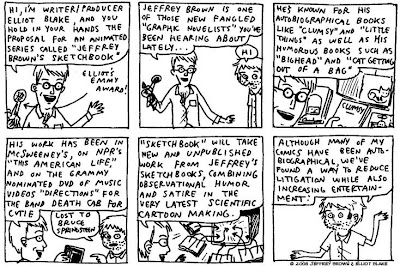 Now, we could tell you here on the blog how "we've found a way to reduce litigation while also increasing entertainment," but that would be kind of like giving away the farm. However, if you're an entertainment and/or animation network and/or internet video website executive with discerning taste in indie comics, we'd be happy to send you a package including the full mini-comic containing the answer to this age-old dilemma, so succinctly laid out by Jeffrey above in panel number 6. Just shoot me an email care of info@9panelgrid.com.
(I'd also recommend this animated trailer for Jeffrey's book Little Things, from Touchstone Books.)
-EB
Just about four years ago, I approached Jeffrey about the possibility of adapting his superhero parody/homage Bighead into a cartoon. But over time, the idea of doing something completely original became appealing, which resulted in Sketchbook. Here's an excerpt from the exclusive mini-comic drawn by Jeffrey for the pitch:
 Now, we could tell you here on the blog how "we've found a way to reduce litigation while also increasing entertainment," but that would be kind of like giving away the farm. However, if you're an entertainment and/or animation network and/or internet video website executive with discerning taste in indie comics, we'd be happy to send you a package including the full mini-comic containing the answer to this age-old dilemma, so succinctly laid out by Jeffrey above in panel number 6. Just shoot me an email care of info@9panelgrid.com.
(I'd also recommend this animated trailer for Jeffrey's book Little Things, from Touchstone Books.)
-EB
Wednesday, March 4, 2009
Mekano Turbo!
 Above is the character line-up from Mekano Turbo (click for full image), a full-on crazy pastiche of post-apocalyptic road movies, Japanese robot cartoons, and Venezuelan mythology, created by my collaborator on The Package, Alexis Ziritt. Alexis recruited me Tuesday night to help him out with a story for the Image Comics anthology book Popgun, which he needed to pitch today. So after mainlining a bunch of reference material and ideas Alexis sent me last night, this morning I sat down at the old iBook G4 and, completely inspired by the notion of doing something altogether different, banged out an outline for an 8-page story. And by 3:00 today, I found out our story pitch was accepted by the guys at Popgun. Next on the list: a script so Alexis can start drawing. This is going to be fun.
-EB
Monday, March 2, 2009
Once Again, I Am Blog Delinquent
So I looked up and suddenly a week had gone by without a blog update. Bad blogger. BAD BLOGGER!
Busy week last week. Busy week this week. But I will endeavour (yes, I spell it British-style) to be more topical this week. Hopefully, I'll have a link to post for the trailer I produced for Wildstorm, an imprint of DC Comics. That would be cool.
Here's something I'm excited about: one of my favorite comics writers, Ed Brubaker, has a made for the web movie debuting today on Sony's video site Crackle. It's called Angel of Death, and it stars Zoe Bell, Doug Jones, Ted Raimi, and Lucy Lawless. Very Cool. Can't wait to watch it.
-EB
Saturday, February 21, 2009
The Package - In Progress
Illustrator Alexis Ziritt has been hard at work on our crime comic collaboration, The Package, and he sent me a preview of page 1, in progress (click for larger image):
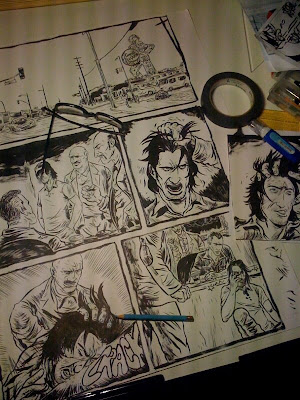
This is going to be gorgeous comic, done in a European pulp style. To merely say I'm excited about it would be an understatement. For more amazing work by the talented Mr. Ziritt, check out his Flickr photo stream, and this website, Perro Tureco.
-EB

This is going to be gorgeous comic, done in a European pulp style. To merely say I'm excited about it would be an understatement. For more amazing work by the talented Mr. Ziritt, check out his Flickr photo stream, and this website, Perro Tureco.
-EB
Thursday, February 19, 2009
Decatur Book Festival 2009
I had such a good time last year being part of the Decatur Book Festival as a professional writer that I decided to volunteer this year to help with programming. We're trying to get Neil Gaiman, the brilliant author of novels (American Gods), comics (Sandman), and children's books (Coraline) to come this year, and you can help by clicking on the widget below:
Go ahead, click it to show Neil how much we want him to come to Decatur, even if you don't live in here. It's a tremendous event.
-EB


Go ahead, click it to show Neil how much we want him to come to Decatur, even if you don't live in here. It's a tremendous event.
-EB
Sunday, February 8, 2009
Motion Comics Are Here
The big news coming out of the New York Comic-Con this weekend - mainstream superhero comics news, anyway - was the announcement of in-continuity Spider-Woman motion comics by Marvel Comics' top writer, Brian Michael Bendis, and his brilliant long-time collaborator Alex Maleev. You can read interviews about this new venture here and here. I was particularly encouraged by what Bendis had to say; he recognizes that motion comics are neither comics nor animation, but instead something somewhere in between, and perhaps a totally new form of graphic fiction. And not without their challenges, as I wrote about recently. I'm going to write more about the topic this week when I've had a little more time to digest this news and do some additional research, but having Bendis tackle this nascent form of sort-of comics storytelling is a good thing. He's a smart writer, his work I think is ideally suited to this kind of limited animation, and he's a mensch. Which is neither here nor there, but I had the pleasure of interviewing him once for pilot I shot for GameTap TV (you can read about that experience here), and he was a mensch.
More on this soon.
-EB
-EB
Saturday, January 24, 2009
Motion Comics
There's been a lot of talk lately about "motion comics," which is the process of taking an existing comic book property and turning it into a video by adding some limited animation, voice work, music, and sound effects, as has been done with the high-profile "motion comics" adaptations of Watchmen and Batman: Black & White (both of which are available on iTunes). "Motion Comic" itself is an oxymoronic term, as comics are a static medium; to quote Mark Waid, again, "a comic story is made up of frozen moments. Screen stills. Snapshots." So it's a tough thing to create a "motion comic," because by adding motion what you have created is, by definition, no longer a comic. It's an argument of semantics, I know, but "motion comic" is ultimately just a fancy name for "limited animation." Nevertheless, since "motion comics" is now the term in common use, I'll bow to convention and use it from this point forth sans the quotation marks.
So, as I said above, it's a tough thing to make a motion comic, for a couple of reasons beyond semantics: 1) if you're too respectful of the material, as I feel was the case with the adaptation of the first issue of Watchmen, you wind up with something that's poorly paced and too limited in animation; and 2) it's easy to get too tied to the tropes of the medium you're trying to adapt, especially the word balloons. Both the Watchmen motion comic and MTV's adaptation of Invincible use the world balloons in conjunction with voiceover, despite the fact that having the characters speak obviates the need for the balloons themselves. It's a young medium, motion comics, and how you can adapt a comic into something less than full animation but more than an animatic, with a (presumably) limited budget and schedule is still being figured out.
But...
...if you'd like to see what I think is a good example of an early motion comic, I'd like to offer the following episode of the GameTap series Re\Visioned: Tomb Raider - "A Complicated Woman." Produced by me, written by Jim Lee and Christos Gage, designed and laid out by the fine Wildstorm crew of Carlos D'Anda, Michael Lopes, JJ Kirby, and Oliver Nome, with final animation by the San Francisco based studio Ghostbot.
We were not setting out to make a motion comic with this episode of Re\Visioned - the term had not yet been invented when we got started in mid-2007 - but in early talks, Wildstorm VP-General Manager Hank Kanalz and I (with the blessing of Re\Visioned series creator/GameTap VP Rick Sanchez and executive producer Chris Peeler) quickly arrived at a creative strategy that would play to Wildstorm's strengths as a comic book studio - we would make a living comic book, utilizing limited animation and great Wildstorm art. I think we arrived at a reasonable hybrid, still employing some of the tools of comics, such as visible sound effects, captions, panel borders, and dynamic posing, and marrying those to animation that was for the most part very limited, except for in a couple of action sequences which received a more fully animated treatment for greater impact. Is it perfect? No, but I do think this could provide a good road map for future attempts at motion comic creation.
And I'm available for just that sort of thing, by the way - if you have any questions, please contact me via the email link in my profile to the right.
-EB
p.s. I found the video on YouTube, evidently uploaded by someone in Russia who felt like pirating the video gave them enough ownership to put their own logo over it. CroftNotes.ru had nothing to do with the making of "A Complicated Woman."
Tuesday, January 20, 2009
Good Comics Writing
We'll take a break from politics in order to turn to another obsession of mine: comic books. It's no secret that I like comics, and that I have strong opinions about what makes a good comic. So, as a writer, I've decided to discuss comics writing that I think is of exceptionally good quality, and fully embraces the strengths of the medium to tell compelling, gripping stories. First on that list is the outstanding Vertigo crime title Scalped, created by writer Jason Aaron and artist R.M. Guera.
I don't want to give away too much, because I think you should go and buy it, but Scalped takes place on an Indian Reservation in South Dakota plagued by unemployment and crime, and centers on a cast of characters led by Dashiell Bad Horse, son of a former radical who has returned to the rez after years away. Dash, who has some issues with anger and his mother, has taken a job with the Tribal Police at the behest of corrupt tribal chief Lincoln Red Crow. Chief Red Crow, meanwhile, has brought a casino to the rez in order to try and provide a better life for his people, but has gotten into bed with some nasty characters to make it happen.
Aaron and Guera have done a remarkable job bringing these characters, along with smaller supporting roles, to unique life; the dialogue rings true, the situations are compelling and dire, and the artwork provides firm ground for each character's desperation and regrets. The whole thing comes across as intensely cinematic - or, tv-matic, if you will - it would make a great HBO series. That said, don't wait for HBO - go out and buy the collected editions at your local comic shop. Really.
In the last issue to hit the shelves, #24, I came across a six panel sequence that, in my opinion, is one of the best uses of time I have ever seen in a comic. Time in comics is a funny thing, because, as Mark Waid puts it, "a comic story is made up of frozen moments. Screen stills. Snapshots." So how do you control time in a comic? The answer, at least in part, is through the use of space. The artist can break up a moment - say, someone reaching for a gun - into a bunch of panels, or just represent that action in a single panel. There are a lot of options for pacing, but ultimately, much of that control is ceded to the reader and his or her interpretation of what's on the page. So how does this apply the sequence I was referring to in Scalped #24? See below (click image for larger):
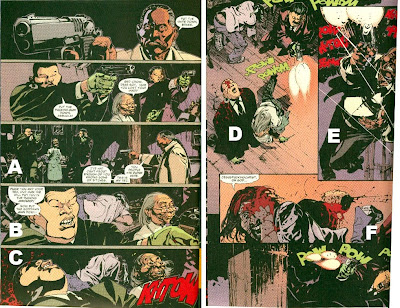 In these two pages, Chief Red Crow walks into a bar interrupting some bad guys doing some bad things on his reservation, and gets into a gunfight. I've labeled the panels A-F - now let's break down what's happening, and why I think this sequence is noteworthy:
Panel A - Take a look behind the short guy in the apron - laying on the bar is Dino Poor Bear.
Panel B - A clearer shot of Dino behind the bad guys, one of whom is telling Red Crow to put down his gun.
Panel C - This is where it gets really interesting. Left to right, three things are happening in a fraction of a second - the thuggish bad guy gets shot in the head; Dino starts to pick himself off the bar, and the short guy (Brass) reacts.
Panel D - The thug hasn't quite dropped to the ground yet; Dino is making his way off the bar; Brass dives for cover; and the other thug opens fire on Chief Red Crow.
Panel E - Chief Red Crow returns fire.
Panel F - Dino makes it off the bar and scrambles for cover, while the dead thug finally starts falling backwards.
What makes this sequence special, and unique to comics, is that it's happening quickly and in slow motion simultaneously - the beginning of the shootout is represented as if in the blink of an eye, but Dino, terribly wounded, seems to be moving in slow motion. It's virtuoso piece of comics writing, perfectly served by the art. So now that you're as impressed as I am, go out and buy Scalped - you'll be glad you did.
-EB
p.s. Long-time comics writer and editor Mark Waid is doing a weekly column on comics writing at John Rogers' Kung Fu Monkey blog, which you can find here. I highly recommend it.
I don't want to give away too much, because I think you should go and buy it, but Scalped takes place on an Indian Reservation in South Dakota plagued by unemployment and crime, and centers on a cast of characters led by Dashiell Bad Horse, son of a former radical who has returned to the rez after years away. Dash, who has some issues with anger and his mother, has taken a job with the Tribal Police at the behest of corrupt tribal chief Lincoln Red Crow. Chief Red Crow, meanwhile, has brought a casino to the rez in order to try and provide a better life for his people, but has gotten into bed with some nasty characters to make it happen.
Aaron and Guera have done a remarkable job bringing these characters, along with smaller supporting roles, to unique life; the dialogue rings true, the situations are compelling and dire, and the artwork provides firm ground for each character's desperation and regrets. The whole thing comes across as intensely cinematic - or, tv-matic, if you will - it would make a great HBO series. That said, don't wait for HBO - go out and buy the collected editions at your local comic shop. Really.
In the last issue to hit the shelves, #24, I came across a six panel sequence that, in my opinion, is one of the best uses of time I have ever seen in a comic. Time in comics is a funny thing, because, as Mark Waid puts it, "a comic story is made up of frozen moments. Screen stills. Snapshots." So how do you control time in a comic? The answer, at least in part, is through the use of space. The artist can break up a moment - say, someone reaching for a gun - into a bunch of panels, or just represent that action in a single panel. There are a lot of options for pacing, but ultimately, much of that control is ceded to the reader and his or her interpretation of what's on the page. So how does this apply the sequence I was referring to in Scalped #24? See below (click image for larger):
 In these two pages, Chief Red Crow walks into a bar interrupting some bad guys doing some bad things on his reservation, and gets into a gunfight. I've labeled the panels A-F - now let's break down what's happening, and why I think this sequence is noteworthy:
Panel A - Take a look behind the short guy in the apron - laying on the bar is Dino Poor Bear.
Panel B - A clearer shot of Dino behind the bad guys, one of whom is telling Red Crow to put down his gun.
Panel C - This is where it gets really interesting. Left to right, three things are happening in a fraction of a second - the thuggish bad guy gets shot in the head; Dino starts to pick himself off the bar, and the short guy (Brass) reacts.
Panel D - The thug hasn't quite dropped to the ground yet; Dino is making his way off the bar; Brass dives for cover; and the other thug opens fire on Chief Red Crow.
Panel E - Chief Red Crow returns fire.
Panel F - Dino makes it off the bar and scrambles for cover, while the dead thug finally starts falling backwards.
What makes this sequence special, and unique to comics, is that it's happening quickly and in slow motion simultaneously - the beginning of the shootout is represented as if in the blink of an eye, but Dino, terribly wounded, seems to be moving in slow motion. It's virtuoso piece of comics writing, perfectly served by the art. So now that you're as impressed as I am, go out and buy Scalped - you'll be glad you did.
-EB
p.s. Long-time comics writer and editor Mark Waid is doing a weekly column on comics writing at John Rogers' Kung Fu Monkey blog, which you can find here. I highly recommend it.
Monday, January 19, 2009
Really!
I'm going to get to that comics writing post spotlighting Jason Aaron's Scalped. Tomorrow, even. I shall dare to post about comics on Inauguration Day.
Quite possibly I will live-blog Obama's inaugural speech, as well.
-EB
Quite possibly I will live-blog Obama's inaugural speech, as well.
-EB
Friday, January 16, 2009
Memo to President-Elect Obama Re: New Cabinet Post
 Dear Mr. President-Elect:
I'm sure that you've heard - despite how busy you've been with things like the transition and trying to figure out how to save our faltering economy - that your issue of Amazing Spider-Man (#583, above) has been a runaway success, and that people were lining up at comics shops all over the country to get a copy of it to celebrate your inauguration.
We all know you're a comic book fan from way back, and that you collected Spider-Man and Conan comics as a kid, so I would like to propose a new cabinet-level post in your administration: Secretary of Comic Book Affairs, for which I humbly submit...myself. I was an ardent supporter of your candidacy, I'm something of an expert on the subject of comics, and perhaps most importantly, I'm between gigs, so I'm available to start immediately after what is sure to be a smooth confirmation hearing in the Senate. No Holder hardball or Geithner back-tax brouhaha here. Elliot Blake is squeaky clean.
So here's how it would work: every Wednesday (you and I and our fellow comic book devotees know it best as "New Comics Day"), right after your morning security briefing, I will provide you with a five-minute summary of the storylines of the week's comics, alerting you to your own appearances in books like Marvel's Thunderbolts #128 (here's a glimpse)...
 ...or Rob Liefeld's Youngblood #8:
 I could also offer some useful counsel regarding these appearances, such as: "Look out for that Norman Osborn, sir! He's really a bad guy - one you've surely heard of as a Spider-Man fan - The Green Goblin!"; and, "We might want to limit your appearances in Rob Liefeld-drawn books, sir - there's a real possibility that you'll be rendered with tiny feet, excessively gritted teeth, and an overabundance of cross-hatching." Although, in fairness to Mr. Liefeld, I would also note that those complaints are practically cliché, and that he did a fine job drawing you from a photograph in the cover above. That's an example of how I would fit into your big-tent style of governance, by the way - I'm not much of Liefeld fan, but I am capable of pointing out decent work when I see it.
Secretary of Comic Book Affairs, sir. Potentially a very valuable post, and I hope you'll consider it. I await your call.
Best regards,
Elliot Blake
Wednesday, January 7, 2009
The Package
I'm writing a crime comic called "The Package" with the amazing illustrator Alexis Ziritt of Calavera Comics, who sent me some rough ads he mocked up before the holidays as a tune-up of sorts for diving into the art for the story. I thought I'd share them here:


 To say I'm excited about this project would be a serious understatement. More on this to come.
-EB


 To say I'm excited about this project would be a serious understatement. More on this to come.
-EB
Subscribe to:
Posts (Atom)


 Posts

